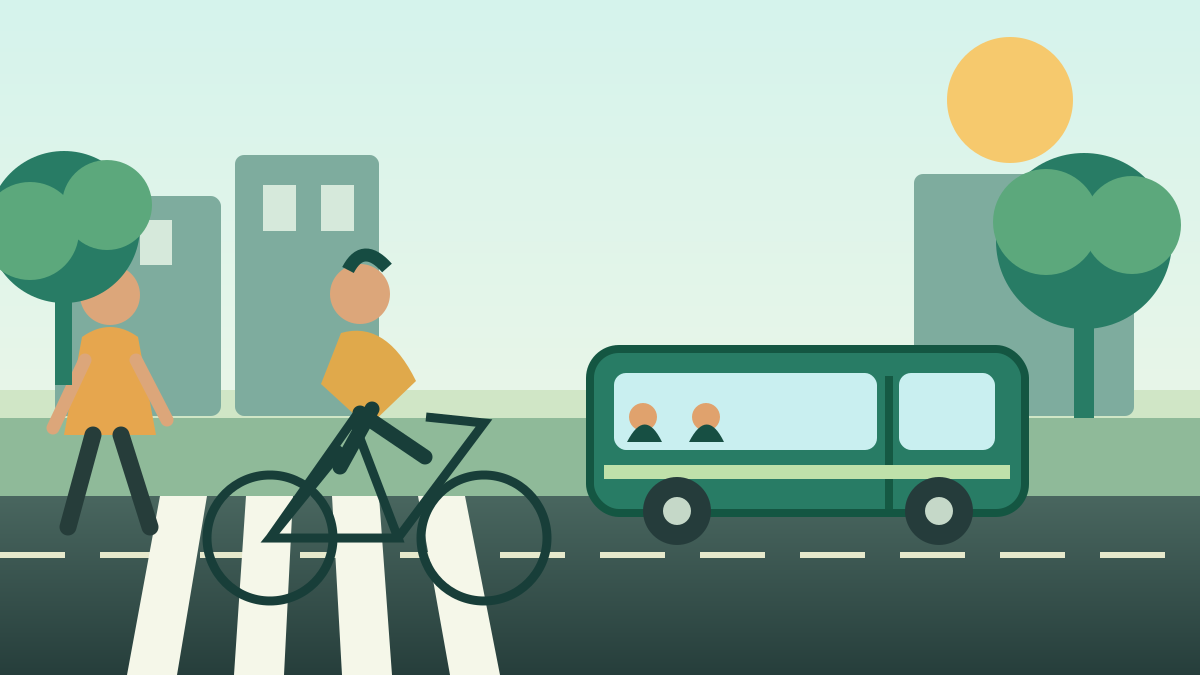
Why mobility matters for climate and health
Travel affects more than journey times. It shapes air quality, climate emissions, noise, road safety and the amount of public space available to everyone. According to the European Environment Agency's 2025 assessment, transport including international bunkers accounted for approximately 31% of EU greenhouse gas emissions in 2023. This is an EU-specific figure, not a global or Turkish share.
Türkiye's 2026 national inventory submission to the UNFCCC reports about 102.87 million tonnes of CO₂ equivalent from transport in 2024. Personal choices matter, but a transition also requires safe pavements, accessible services and good planning. Responsibility should not fall solely on individual travellers.
Choose for the journey, not for a slogan
Walking can work for short, safe trips; cycling can cover some medium-distance journeys; and public transport can serve longer or more complex routes. Yet weather, disability, age, caring for children, work schedules and road conditions all influence what is feasible. There is no single best mode for everyone.
Compare a week's journeys by distance, time, cost, transfers, safety and accessibility. Walking to a bus stop or combining a bicycle with a train can also be valuable. Combining errands on one trip may reduce unnecessary travel without asking anyone to abandon essential activities.
Safety comes before a mode switch
Use marked crossings and well-lit routes. At junctions, check that drivers have noticed you. On a bicycle, follow local traffic rules, use appropriate protective and visibility equipment, and avoid phone distraction. When travelling with children, prefer separated infrastructure and safe crossings over the shortest possible route.
WHO Europe reports that walking and cycling can increase physical activity and help reduce pollution and climate impacts. However, those benefits depend on safer streets and traffic management. Nobody should be pressured to cycle on a dangerous road to demonstrate environmental commitment.
Public transport and shared journeys
Buses, metro systems, trams and suburban trains can lower per-passenger impacts, particularly when occupancy is good. The result still depends on vehicle type, energy source, route and ridership. Electric vehicles can reduce tailpipe pollution, but manufacturing, electricity supply and tyre-related impacts do not disappear.
Before travelling, check stop accessibility, the last service, transfer time and service reliability. Where driving is necessary, grouping errands, sharing suitable journeys and avoiding unnecessary idling are realistic intermediate measures.
A transparent trip calculation
Imagine a commute of 4 km each way, five days a week. That is 8 km a day or 40 km a week. Replacing two safe round trips by walking or cycling could avoid 16 vehicle-km of car travel in that week. This is not a directly measured CO₂ saving.
Estimating emissions requires the actual car's fuel use, fuel type, occupancy and the characteristics of any alternative service. Online calculators provide estimates, not precise measurements. Do not double-count avoided distance when a shared car would have travelled anyway.
Accessibility and fair mobility
Continuous pavements, safe crossings, accessible stops and reliable information matter to older people, disabled travellers, children and people using pushchairs. A transport plan is not inclusive if it overlooks these needs while calling itself green.
For a school or neighbourhood activity, document missing ramps, poorly lit crossings and inaccessible stops without collecting personal location histories. Reporting barriers to the relevant local authority may achieve more lasting change than asking individuals to change habits alone.
A seven-day mobility experiment
Day 1: Record journey purposes and distances. Day 2: Review a safe walking route. Day 3: Check public transport time and accessibility. Day 4: If safe, replace one short car journey with walking. Day 5: Explore protected cycling routes or bike-and-transit options. Day 6: Identify errands that can be combined. Day 7: Compare time, cost, safety and vehicle-km.
In school activities, never ask children to disclose home addresses, live locations or personal routes. Use hypothetical neighbourhood maps and anonymous totals; exclude unsafe journeys from the experiment.
Common questions and misconceptions
Is every cycle trip safe? No; infrastructure and conditions matter. Is public transport always zero-emission? No; vehicle and energy sources matter. Do electric cars solve every transport problem? No; congestion, land use and unequal access may remain.
Should everyone walk to work? No. The goal is to expand realistic, fair and safe choices. Start with one change that suits your circumstances.
Sources and scope
Statistics refer to the places and years specified by each source. Local choices depend on current infrastructure and safety.