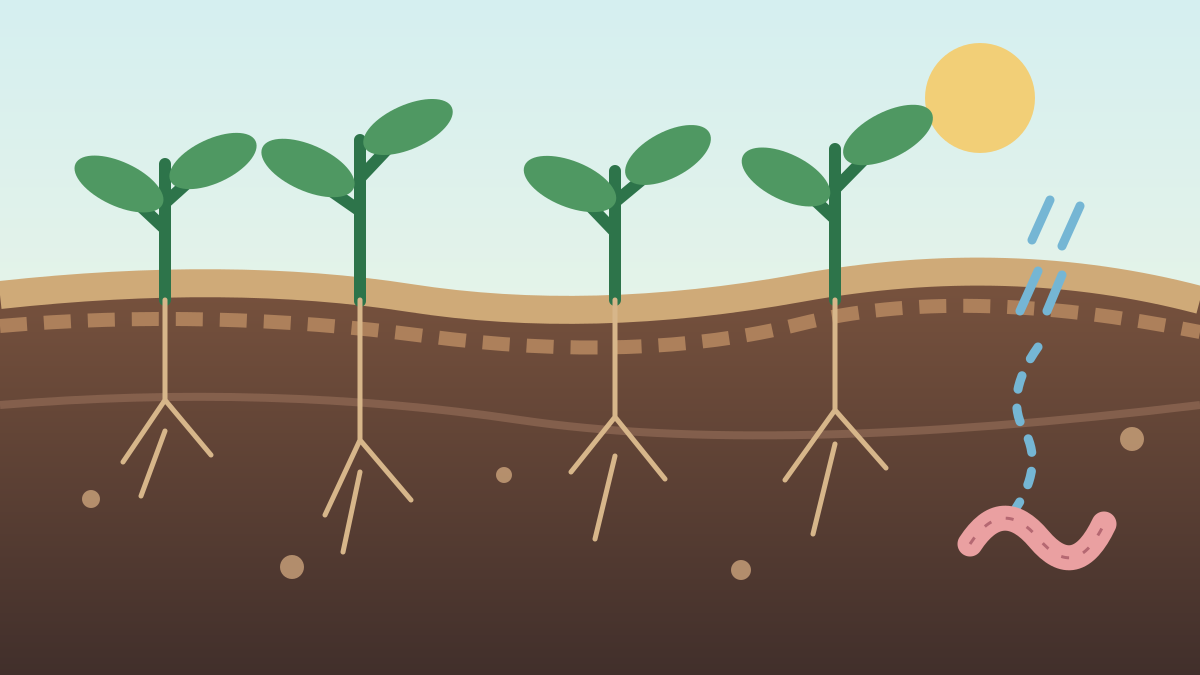
What makes soil healthy?
Healthy soil can absorb and store water, cycle nutrients and sustain plant roots and a diverse community of organisms. Mineral particles, organic matter, air spaces, fungi, bacteria and invertebrates all play a role. Dark colour alone is not a reliable diagnosis: structure, drainage and plant growth need to be considered together.
The FAO describes soil as a resource that forms extremely slowly. Protecting the soil already in place is therefore often more useful than repeatedly digging it up or importing replacement material. A classroom project should focus on sound management and careful observation rather than claiming that soil has been restored in a few days.
How does erosion happen?
Erosion is the movement of soil particles, especially valuable surface material, by water or wind. Raindrops can detach particles on bare ground, while runoff on slopes carries them away. Removing vegetation, leaving soil exposed and disturbing it repeatedly can increase the risk, although local rainfall and terrain also matter.
After rain, look for small channels, deposited sediment or exposed roots. Muddy water alone does not prove severe erosion, but repeated observations can reveal patterns. Students must not attempt to stabilise steep slopes, retaining walls or flood-prone ground themselves. Those situations require school approval and qualified technical assessment.
Four principles for living soil
USDA NRCS highlights four principles relevant to small gardens: minimise soil disturbance, maximise soil cover, increase plant diversity and maintain living roots for as much of the year as possible. The principles reinforce one another; none is a magic treatment that guarantees a specific result.
In practice this may mean avoiding unnecessary digging, keeping a suitable protective layer on exposed ground and choosing a variety of locally appropriate plants. A diverse planting plan should also consider water needs, seasonal care and invasive species risks. Teachers should select measures that the school can maintain after the initial project.
Mulch and organic matter
Mulch is a protective layer placed on the soil surface. Clean leaves, straw or suitable shredded plant material can soften the impact of raindrops, moderate moisture loss and sometimes limit weed growth. The correct depth depends on the plants and climate; piling thick mulch directly against stems may cause problems.
Mature, appropriate compost can contribute organic matter, but not every leftover belongs in the ground. Raw food waste can attract pests, and unknown fill material or chemically contaminated wood should never be used in a school garden. Composting, fertilisation and laboratory soil testing address different questions and should not be confused.
Water infiltration and compaction
Pores between soil particles allow water to move into the ground. Repeated foot traffic and heavy machinery may compact soil and make surface pooling or runoff more likely. Separating paths from planting beds, avoiding unnecessary work on wet ground and protecting established roots are practical ways to reduce disturbance.
For a simple observation, photograph two safe locations after rainfall and record pooling, ground cover and plant condition. Do not drill holes or modify drains without authorisation. If students want a more formal infiltration test, a teacher should choose a consistent method and explain its limitations; a single observation cannot establish a trend.
A safe school garden comparison
With permission, choose a small area away from roads, underground services and other hazards. Record sunlight, slope, existing vegetation and visible runoff. Keep one section unchanged and apply only school-approved mulch or suitable planting to another. Use identical photo locations and dates for comparison.
This is an educational comparison, not a laboratory certification of soil health. Students should wear gloves and avoid sharp tools and chemical treatments. If they encounter broken glass, animal waste, suspicious materials or possible contaminated soil, they should stop and alert school staff instead of touching or removing the material.
What can be measured honestly?
A useful log records date, weather, percentage of visible bare ground, plant types, fixed photo locations and any pooling or sediment. Students can compare observations over weeks or months and discuss why season and maintenance affect results. Observe soil organisms without damaging their habitat.
Do not claim a precise carbon-sequestration benefit, percentage reduction in erosion or water savings from a seven-day activity. Such figures require validated methods, longer monitoring and often professional input. The defensible outputs are the observation records, student learning and a practical maintenance plan.
A seven-day soil care plan
Day 1: Obtain permission and complete a safety check. Day 2: Map covered and bare ground. Day 3: Record visible runoff after rain if conditions are safe. Day 4: Research suitable local plants and clean mulch. Day 5: Agree on one small, supervised protective measure.
Day 6: Establish repeatable photo points and complete the observation log. Day 7: Present the findings and set a monthly review date. Continue monitoring through different weather conditions. A careful record is more valuable than a rushed claim that the garden's soil has been 'fixed'.
Sources and practical notes
This guide is for general environmental education. Local safety rules, school permissions and professional advice take priority.